There are few sounds more disheartening for a homeowner than the loud, sickening crack of a tree splitting during a storm. In Indiana, where our weather swings wildly from heavy ice accumulation in winter to severe thunderstorms in summer, our trees take a beating. But when a tree fails, it rarely happens just because the wind blew too hard. Often, the damage is the final result of a structural defect that has been hiding in plain sight for years.
Crown splitting—where the main branching structure of the tree tears apart—is a significant threat to property and safety. It can split a beautiful shade tree down the middle, often rendering it unsalvageable. For Indianapolis residents, the risk is compounded by common landscape choices and our specific climate challenges.
The good news is that crown splitting is not inevitable. With the right eye for detail and proactive care, you can identify weak points in your trees before they turn into emergency removals. Understanding the mechanics of how trees grow, and where they fail, is the first step in protecting your landscape investment.
Why Do Trees Split? (It’s Not Just the Weather)
While a heavy ice storm or a straight-line wind might be the trigger, the gun was likely loaded years ago by the tree’s own growth pattern. Understanding the physical and environmental causes of splitting can help you spot trouble early.
The “V” vs. “U” Shape
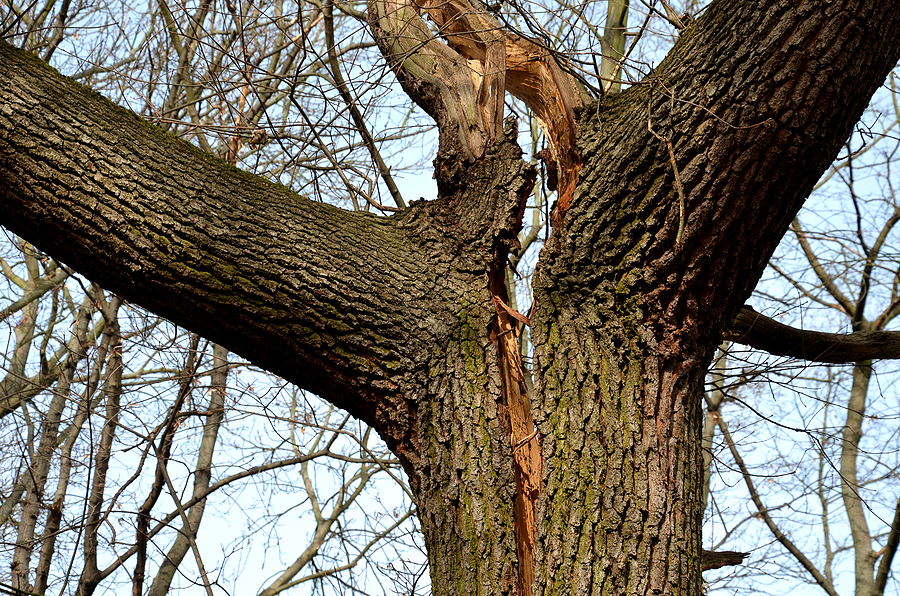
One of the most common culprits of crown splitting is the formation of codominant stems. This happens when two or more main stems grow upward at roughly the same rate and diameter, competing to be the leader.
According to Purdue University Extension, these stems often form a “V” shape at their union. This is structurally much weaker than a “U” shaped union. In a “U” shape, the wood fibers overlap and interlock, creating a strong hold. In a tight “V” shape, the stems push against each other as they grow in girth, forcing the union apart rather than holding it together.
The Danger of Included Bark
Closely related to codominant stems is a condition called included bark. This occurs when bark gets trapped between two growing stems. Because bark does not bond with wood, this creates a physical barrier inside the branch union. There is no connective tissue holding the stems together at that specific point—just bark pressing against bark.
As the tree grows, this pressure builds. When you add the weight of a heavy Indianapolis snow or the torque of high winds, that weak point acts like a zipper, causing the tree to tear apart. Species common in the Midwest, such as the Bradford Pear and Silver Maple, are notorious for this issue. The Bradford Pear, in particular, almost invariably develops weak, codominant stems that shatter under ice loads.
Environmental Stressors in Indiana
Our local climate plays a massive role in tree failure.
- Ice Storms: Accumulation of ice adds massive weight to the tree canopy. A tree with weak branch unions cannot support this extra load.
- Wind Loading: Summer storms in the Midwest often bring high winds. If a tree has a heavy, unbalanced crown, the leverage placed on the trunk can snap it at its weakest point.
Schedule Emergency Tree Removal in Indianapolis Now ✅
Preventative Measures: Strengthening Your Trees
You don’t have to wait for a storm to see if your trees will survive. There are proven arboricultural practices that can significantly reduce the risk of failure.
Structural Pruning
The best way to prevent splitting is to correct the tree’s structure while it is young. Structural pruning focuses on developing a single, dominant leader and strong branch attachments.
- Establish a Central Leader: You want one main trunk running up the center of the tree. Competing stems should be removed or shortened (subordinated) so they don’t overtake the main leader.
- Watch the Aspect Ratio: Purdue Extension advises maintaining a branch aspect ratio of less than 50%. This means the side branch should be less than half the diameter of the trunk it is attached to. Small branches attach strongly; large branches that are nearly the same size as the trunk are more prone to splitting.
- Timing Matters: Structural pruning is most effective in the first 25 years of a tree’s life. However, even mature trees can benefit from reduction cuts that lower the weight on long, heavy limbs, reducing the “lever arm” effect during high winds.
Cabling and Bracing systems
For older trees that already have structural defects but are too valuable to remove, cabling and bracing can provide supplemental support.
- Cabling: This involves installing flexible, extra-high-strength steel cables high in the tree’s crown. The cables connect two or more limbs, limiting how far they can move apart during a storm. This restricts the sway and reduces the strain on weak unions.
- Bracing: This is a more rigid solution where threaded steel rods are drilled through a weak branch union to bolt it together. This is often used in combination with cabling to prevent the trunk from splitting.
Note: These systems must be installed according to ANSI A300 standards. Incorrectly installed hardware can damage the tree further or create a false sense of security. As noted by forestry specialists, these systems do not eliminate risk entirely but can extend the life of a cherished tree.
When to Call a Professional Tree Service
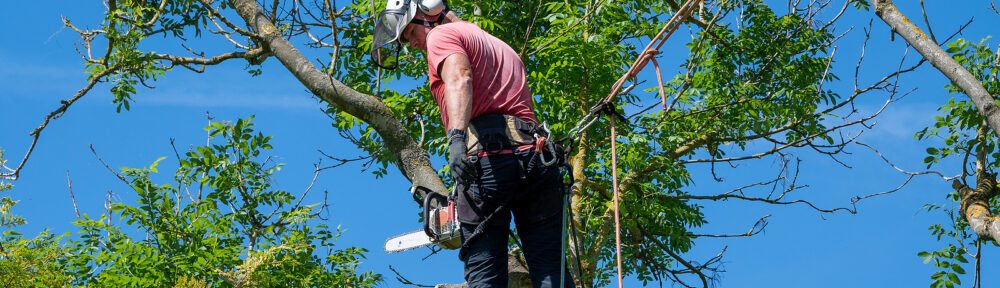
Tree work can be dangerous. While pruning a small sapling is a great DIY project, managing the crown of a mature Oak or Maple is a job for experts. You should call a professional tree service if:
- The tree is large: Any work that requires leaving the ground should be handled by an insured professional.
- You see cracks: If you notice a visible crack in a branch union or the trunk, this is an emergency. The tree is actively failing.
- Cabling is needed: Installing high-tension cables requires specialized hardware and knowledge of physics and tree biology.
Sometimes, despite our best efforts, a tree has simply become too hazardous to keep. If a tree has a massive split in the main trunk or significant decay in the roots, removal is often the safest option to protect your home and family.
In Summary
Crown splitting is often a silent problem until it becomes a loud, destructive one. By keeping an eye out for “V” shaped unions, avoiding species prone to failure like Bradford Pears, and investing in regular structural pruning, you can help your trees weather the erratic Indiana seasons. A small investment in maintenance now can save you the heartache—and cost—of a crushed roof or a lost tree later.
Concerned about a leaning tree or a suspicious crack in your branches? Don’t wait for the next ice storm to find out if it’s safe. Contact Us Today for professional tree removal and tree pruning services in Indianapolis. Our team can assess your trees’ structure and help you decide the best course of action to keep your property safe.
Related Post: Can A Split Tree Trunk Be Saved? Solutions for Indiana Homeowners