Common Indiana Tree Pests and Abatement Strategies

A healthy urban forest brings shade, beauty, and life to your property. But keeping your trees vibrant means protecting them from tiny, sometimes unseen threats. Insects and invasive species can quickly turn a thriving canopy into a brittle, dangerous hazard.

Tree pests aren’t just a cosmetic issue; they cause conditions that can lead to long-term structural damage or even the death of your favorite landscape features. Recognizing the early warning signs of an infestation can mean the difference between saving a beloved tree and having to pay for a costly removal.

Understanding how to identify and treat these invaders is vital for maintaining your property. This guide outlines the most destructive tree pests currently active in Indiana, offering practical, expert-backed strategies to help you protect your landscape and keep your trees thriving all year round.
Call 317-783-2518 to Remove a Pest-Ridden Tree in Indianapolis

How to Identify the Emerald Ash Borer

The Emerald Ash Borer (EAB) is a destructive, metallic green beetle that targets ash trees, causing rapid decline and death within two to five years if left untreated.

Signs of Emerald Ash Borer Infestation

Recognizing an EAB infestation early is critical for saving the tree. The most obvious indicator is a noticeable reduction in canopy coverage, as the top branches begin to die first. You may also spot D-shaped exit holes in the bark, which indicate that adult beetles have emerged. As the damage progresses, large chunks of bark may detach, and the tree will become dangerously brittle. Trees with severe structural weakness often collapse during heavy weather events.

Treatment Options

Treating an infested ash tree is possible, provided the canopy loss is less than 30%. The most effective combination involves injecting the insecticide emamectin benzoate directly into the trunk. Purdue University research indicates that treating trees once every three years provides durable, sufficient protection. At an estimated cost of $300 per treatment, this method is highly cost-effective compared to the $1,800 to $3,600 price tag of removing a dead tree. Spring treatments generally yield the best results.

Dealing with the Spotted Lanternfly in Indiana

The Spotted Lanternfly is an invasive planthopper that feeds on the sap of over 100 plant species, severely weakening trees and leaving behind a sticky residue that promotes fungal growth.

Identifying Egg Masses

First detected in Indiana in 2021, this pest overwinters as egg masses. These masses contain 30 to 50 brownish-yellow, seed-like eggs covered in a whitish-gray waxy layer. As the weather cools, this protective coating turns grayish-brown and closely resembles cracked mud. You can find these patches on smooth tree bark, firewood, rocks, outdoor furniture, or even vehicles parked near infested areas.

Removal Techniques

Managing the Spotted Lanternfly requires a multi-step approach. During the late fall and winter, scraping egg masses with a putty knife and firmly squashing them will reduce the following year’s population. When nymphs emerge in the spring, applying horticultural oils or insecticidal soaps can suppress their numbers. Removing the invasive Tree of Heaven—the insect’s preferred host plant—can also dramatically reduce lanternfly activity on your property.

Managing Bagworm Infestations on Evergreens

Bagworms are caterpillars that build spindle-shaped protective bags out of silk and plant foliage, often defoliating junipers and arborvitae during July and August.

Manual Removal

Because their bags look like natural pine cones or dead foliage, bagworms often go unnoticed until extensive damage has occurred. If you spot them early, the simplest control method is manual removal. Pick the bags off the branches by hand and drown them in a bucket of soapy water. This physical removal is highly effective when done before the eggs hatch in early June.

Chemical Control

Once the caterpillars hatch and begin feeding, manual removal becomes less practical. Spraying the foliage with biorational insecticides ensures the caterpillars consume the treatment. These specific pesticides kill the bagworms without harming beneficial insects. Alternatively, a soil application of dinotefuran applied to the base of the tree in early May allows the treatment to absorb into the foliage right before the eggs hatch.

Recognizing and Treating Japanese Beetle Damage

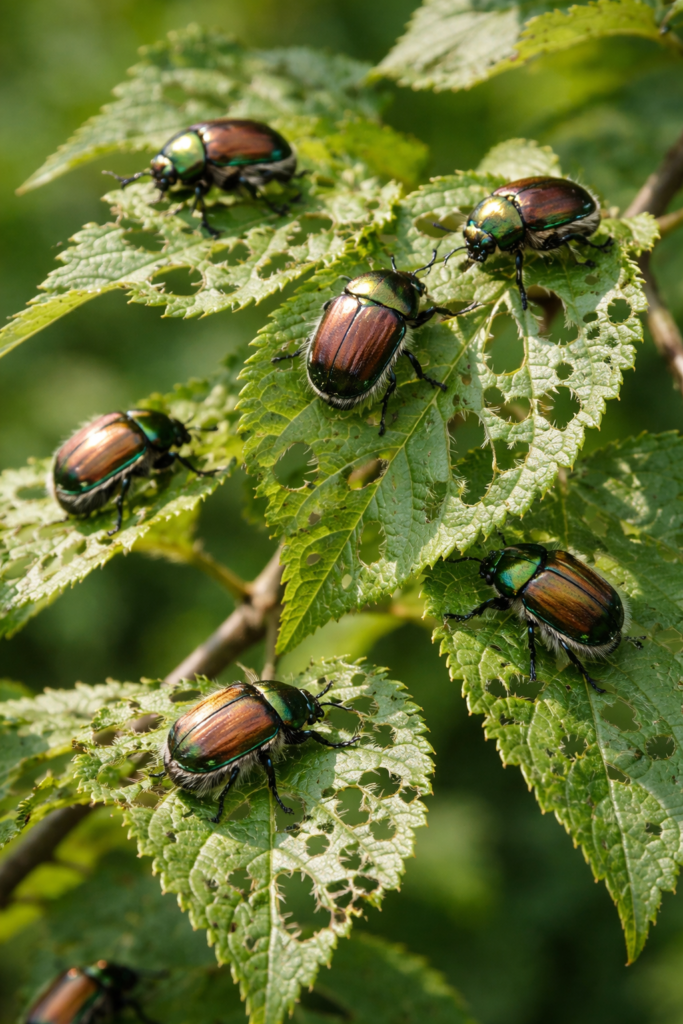
Japanese beetles are metallic green and copper insects that skeletonize tree leaves, eating the green tissue between the veins and leaving a delicate, lace-like appearance behind.

These beetles feed in large groups and can quickly defoliate ornamental trees and shrubs. While healthy, mature trees can usually survive a season of Japanese beetle feeding, repeated defoliation causes severe stress. Hand-picking the beetles and dropping them into soapy water works well for small shrubs.

For larger trees, targeted insecticide sprays can protect the canopy. Use caution with commercial pheromone traps, as they can sometimes attract more beetles to your yard than they capture.

When to Call a Professional for Tree Health

You should contact a certified arborist when you notice severe canopy loss, structural weakness, or widespread pest damage that requires specialized chemical treatments. Diagnosing tree health issues requires a trained eye.

Some symptoms of pest damage mimic those of drought stress or fungal disease. Furthermore, many effective treatments, such as systemic tree trunk injections, require specialized equipment and a commercial pesticide license. An expert can assess the viability of a sick tree and recommend a safe, effective course of action.

Frequently Asked Questions

When is the best time to apply tree pest treatments?

Spring is generally the optimal time for pest treatments. Applying systemic insecticides in the spring allows the tree to absorb the chemicals as it actively pulls water and nutrients up into the new canopy. This timing works exceptionally well for the Emerald Ash Borer and early bagworm prevention.

Are pesticide treatments safe for my property?

Yes, when applied correctly. Always read the label, as the label is the law. To protect pollinators, avoid applying systemic insecticides when nearby trees or groundcovers are actively blooming. Hiring a licensed applicator ensures the treatments are handled safely and legally.

Safeguard Your Landscape Today

Maintaining a healthy canopy requires vigilance, proper identification, and timely intervention. Treating pests early prevents long-term decay and saves you from the safety hazards associated with dead or falling timber.

If you are dealing with a persistent infestation or a brittle, dying tree, do not wait for the problem to escalate. We offer professional tree service, including tree removal and pruning, to keep your property safe and beautiful. Get a free estimate today and let our experts restore your landscape.

Call Now for a Free Quote

Related Post: Tree Pest Protection: How to Keep Nuisance Birds Out of Your Trees

Best Shade Trees to Cool Your Indiana Yard

Losing a mature shade tree to a storm or disease can leave your yard feeling exposed and uncomfortably hot during the peak of an Indiana summer. When the July heat sets in, that missing canopy becomes a glaring problem. You might immediately look for the fastest-growing replacement available to quickly restore your outdoor comfort.

Selecting the right replacement requires balancing your immediate need for shade with the long-term health of your landscape. Fast-growing trees often have weaker wood, making them susceptible to the very ice and wind storms that may have damaged your previous tree. Understanding the specific soil conditions of your property is crucial for making a choice that will survive and thrive.

By carefully matching a tree to your yard’s unique environment, you can cultivate a beautiful, cooling canopy. This guide provides expert recommendations on the best fast-growing and long-lasting native trees for the Midwestern climate, giving you the knowledge needed to make a confident planting decision.

Plant Native Indiana Shade Trees

Top Fast-Growing Shade Trees for Hoosiers

The best fast-growing shade trees for Indiana include the Tuliptree, Freeman Maple, and Thornless Honeylocust, offering quick relief from the sun while adapting well to local soils. When you want shade quickly, it is important to understand the trade-offs.

Purdue Extension notes that species with rapid growth rates generally have shorter lifespans and weaker branch structures. You can still find excellent options that strike a manageable balance between rapid growth and structural integrity.

Tuliptree (Yellow-poplar)

Indiana’s state tree is a spectacular choice for large landscapes. It grows rapidly and produces beautiful, tulip-shaped flowers in the spring, followed by a striking yellow canopy in the fall. Tuliptrees require deep, rich, and well-drained soils to reach their full potential.

Freeman Maple

If you love the look of a classic maple, the Freeman Maple is an outstanding hybrid. It crosses the fast growth of the Silver Maple with the stronger wood and brilliant autumn color of the Red Maple. It adapts well to various environments, though it performs best in well-drained, slightly acidic soil.

Thornless Honeylocust

This tree is highly adaptable to different soil types and urban environments. Unlike its wild counterpart, the landscape variety lacks dangerous thorns. It features small leaflets that provide a pleasant, dappled shade, allowing your turfgrass to continue growing healthy and strong beneath the canopy.

Sweetgum

The Sweetgum is a rapid grower known for its star-shaped leaves and brilliant, multi-colored fall foliage. It is highly attractive, but it does drop spiny seed capsules in the fall. If you plant a Sweetgum, place it away from sidewalks or areas where you might walk barefoot.

Choosing the Best Native Species for Longevity

Call 317-783-2518 for Professional Oak Tree Care in Indianapolis

For a tree that lasts generations, choose robust Indiana natives like the White Oak, Bur Oak, and Black Walnut. The Indiana Department of Natural Resources strongly advocates for planting native species.

Natives are naturally adapted to the state’s fluctuating weather patterns and typical soil pH levels, which generally range from mildly acidic to neutral. They also provide essential habitats and food sources for local wildlife.

White Oak

The White Oak is a majestic, long-lived shade tree that can eventually reach up to 100 feet tall. It thrives in well-drained soils and develops a wide, spreading canopy that provides massive amounts of shade. While its initial growth rate is slower, the resulting strength and beauty make it a cornerstone of any landscape.

Bur Oak

If your property has challenging soil, the Bur Oak is incredibly resilient. It tolerates both wet, poorly drained areas and dry, exposed sites. This tree produces distinct, fringed acorns and features thick, corky bark that protects it from environmental stress.

Black Walnut

Valued highly for its timber and nuts, the Black Walnut is a fantastic native option if you have deep, fertile soil. It is very site-sensitive and will struggle in dry, poor earth. Keep in mind that Black Walnuts release a natural compound called juglone, which can inhibit the growth of certain nearby garden plants, so location planning is essential.

Shagbark Hickory

Named for its peeling, smoky-gray bark, the Shagbark Hickory is a highly attractive native tree. It thrives in a variety of moist soils and provides an excellent habitat for local wildlife, including shelter for native bats.

How to Care for Your New Shade Trees

Proper care involves planting near Arbor Day, prioritizing weed control for the first three years, and avoiding concentrated fertilizers in the planting hole. Securing a healthy tree from a reputable nursery is only the first step. How you plant and maintain that seedling dictates its entire future. Start your planning early and prepare the planting site meticulously.

Timing your planting

The ideal time to plant a new shade tree in Indiana is early spring. Aim to have your sapling in the ground around Arbor Day, which lands on the last Friday in April. This gives the root system time to establish before the stressful heat of summer arrives.

Preparing the hole

Dig a hole that fully accommodates the root system without bending or crowding the roots. Never plant the tree too deeply. The root collar—the flared area where the trunk meets the roots—should sit level with or slightly above the surrounding soil surface. Planting too deep can suffocate the tree and lead to stem rot.

Watering and mulching

Keep the roots cool and moist. Apply a two- to three-inch layer of organic mulch around the base of the tree to retain soil moisture and regulate temperature. Keep the mulch pulled a few inches away from the trunk itself to prevent decay. Water deeply during dry spells, especially throughout the tree’s first few growing seasons.

Controlling weeds and avoiding fertilizer

Weed control is the most critical maintenance activity for a young tree. Grass and weeds fiercely compete for water and nutrients. Maintain a weed-free zone around the base for at least the first three years. Additionally, Purdue Extension experts warn against placing concentrated, salt-based fertilizers directly into the planting hole, as this can severely burn and kill the delicate new roots.

FAQ Section

What is the best soil for planting shade trees in Indiana?

Most native Indiana trees thrive in moist, well-drained loam with a mildly acidic to neutral pH (4.5 to 7.0). Because many residential areas have heavy, compacted clay, it is vital to select adaptable species like the Bur Oak or Freeman Maple, or to aerate and amend the soil prior to planting.

Why are the leaves on my new tree turning yellow?

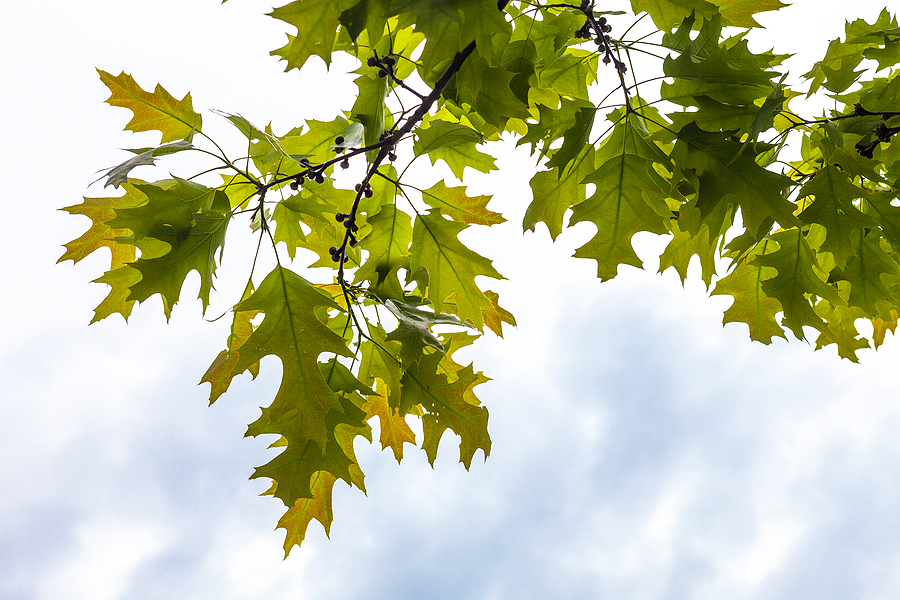
Yellowing leaves, a condition known as chlorosis, often occur when a tree cannot absorb enough iron from the soil. This is incredibly common with species like the Pin Oak when planted in alkaline (high pH) soils. Testing your soil pH before choosing a tree can prevent this issue entirely.

How much space does my shade tree need?

A common landscaping mistake is planting a sapling too close to a house, driveway, or power line. Always research the mature spread of the specific species you are purchasing. Large shade trees generally need to be planted at least 20 to 30 feet away from any permanent structures to prevent root damage and dangerous limb overhangs.

Enjoy a Cooler Summer Under the Perfect Canopy

Transforming a hot, barren yard into a shaded retreat requires patience and careful selection. By prioritizing native species and robust hybrids tailored to your specific soil conditions, you protect your landscape from future storm damage and disease.

Providing rigorous care during those crucial first few years ensures your sapling will mature into a permanent, cooling fixture for your home. Take the time to assess your soil, choose your species wisely, and look forward to relaxing under your own leafy canopy.

If you have large trees that need attention, we are here to help. We offer professional routine tree care in Indianapolis and surrounding counties. From tree trimming and pruning to complete stump removal, we provide expert, safe services at competitive prices. Contact us today to keep your property looking its best.

Call Our Office Now

Related Post: Midwest Tree Planting: A Hardiness Zone Guide

Dead Birch Tree Removal Costs in Indy

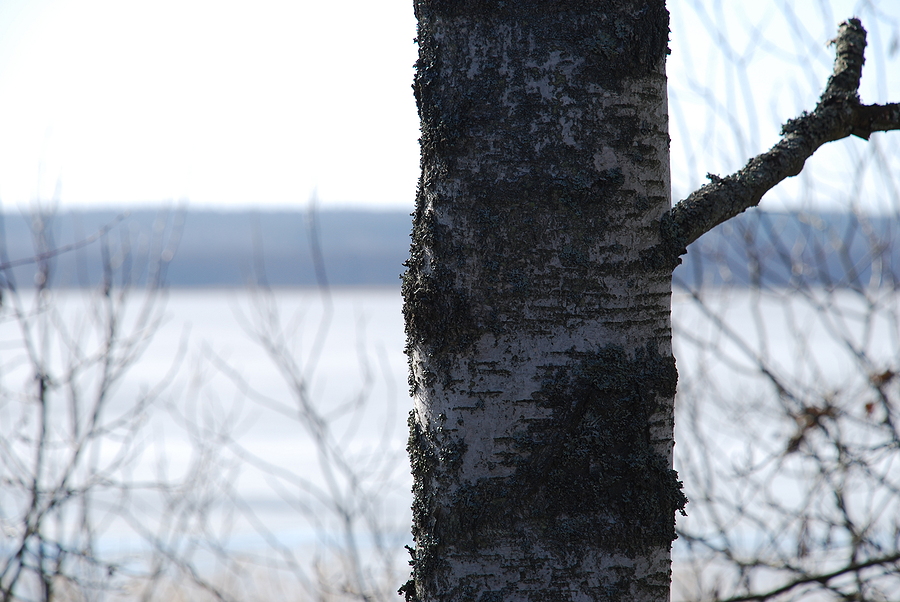
A dead tree standing in your yard is more than a simple eyesore. It is a significant safety hazard waiting for the right gust of wind to cause major damage. Birch trees are famous for their beautiful peeling bark and delicate leaves, but they can become incredibly brittle and dangerous once they die.

As the wood decays, the structural integrity of the tree deteriorates rapidly. This places your home, your family, and your neighbors at risk of sudden falling branches or complete trunk failure. Taking care of a dead tree quickly is a necessary part of responsible property management.

Understanding the financial investment required to safely dismantle and haul away a decaying birch is the first step toward protecting your property. The following guide explores the typical expenses associated with tree removal in Indianapolis and what you can expect when hiring local professionals to handle this delicate task.

Call 317-783-2518 for Affordable Birch Tree Removal in Indianapolis Indiana

What is the Average Cost for Birch Tree Removal?

The average cost to remove a birch tree in Indianapolis ranges from $300 to $600, depending on the height and condition of the tree.

  • Small birch trees under 30 feet tall might cost between $150 and $300 to remove.
  • Medium trees reaching up to 60 feet can cost anywhere from $300 to $700.
  • For extremely large or highly complex removals, the price can climb closer to $1,000.
  • Dead trees often require special care because they are unstable. This added risk can slightly increase the base rate compared to cutting down a healthy, living tree.

Factors Influencing Removal Pricing in Indianapolis

Tree size, accessibility, and the overall health of the wood are the primary factors that determine your final removal quote.

Taller trees with thicker trunks demand more time, labor, and equipment to dismantle safely. A massive river birch will inherently cost more to cut down than a small, ornamental paper birch. The physical volume of branches and wood also dictates how much time the crew spends chipping and hauling away the debris.

Accessibility also plays a massive role in pricing. A tree growing near a fence, home, or power lines requires strategic rigging to bring sections down safely without causing damage. If an Indianapolis tree service cannot bring their bucket trucks or cranes close to the tree, workers must climb or use specialized rope gear. This heavily increases the labor costs.

Finally, a dead birch tree poses unique challenges. Tree care contractors cannot safely climb severely rotted wood. If the trunk is hollow or the branches are falling apart, crews must use aerial lifts or cranes. Bringing heavy machinery to the site elevates the project’s complexity and overall price.

Why Dead Birch Trees Require Professional Removal

Dead trees are unpredictable and highly susceptible to snapping, making DIY removal a severe risk for personal injury and property damage. According to experts at the Purdue University Extension, trees that are dead or dying represent a significant liability for homeowners. Branches lose their flexibility and can break off without warning. Attempting to cut down a dead birch yourself can lead to catastrophic accidents if the trunk buckles or falls in an unintended direction.

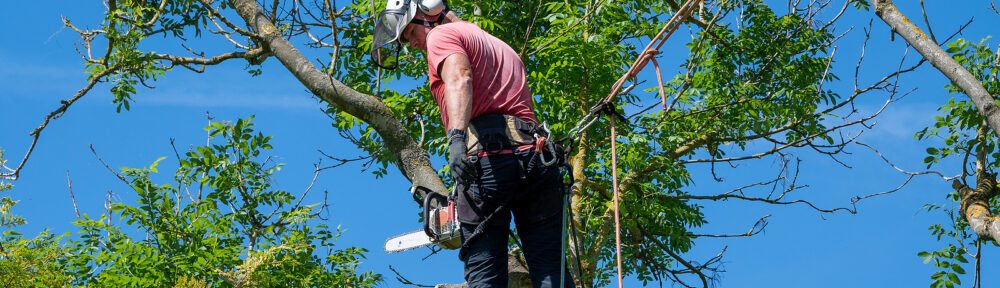
Professionally trained tree techs have the knowledge to assess the decay and determine the safest extraction method. They use specialized rigging and protective equipment to control exactly where each branch lands. This careful planning mitigates the risk of structural damage to your home and keeps everyone on the ground safe.

How to Choose a Local Indianapolis Tree Service

Select a tree care company that carries adequate liability insurance, employs certified arborists, and owns the proper heavy equipment. Not all tree services offer the same level of protection or expertise. You must ensure the company you hire holds comprehensive liability insurance. If an uninsured worker drops a limb on your roof, you could be held financially responsible for the repairs. Asking for proof of insurance is a non-negotiable step in the hiring process.

Look for businesses affiliated with professional organizations, such as the International Society of Arboriculture (ISA). An ISA-certified arborist understands the unique biology of birch trees and recognizes hidden decay. Always ask for written estimates from multiple providers so you can accurately compare their equipment capabilities and pricing structures.

When is the Best Time of Year for Tree Removal?

The dormant season, spanning late fall through winter, is generally the most cost-effective and efficient time to remove a tree. During the colder months in central Indiana, trees lose their leaves. This makes it much easier for crews to see the branch structure and navigate the canopy safely. The frozen ground also helps protect your lawn and landscaping from the heavy tires of bucket trucks and wood chippers.

Tree care companies often experience a dip in demand during the winter. You might secure a more favorable rate or faster scheduling by booking your dead birch tree removal before the busy spring season begins.

Frequently Asked Questions

Do I need a permit to remove a tree in Indianapolis?

For trees located entirely on private residential property, the City of Indianapolis generally does not require a removal permit. However, if the tree sits in the public right-of-way, such as the grassy strip between the sidewalk and the street, rules change. You must obtain a Flora Permit from the Department of Public Works Urban Forestry division before doing any work or hiring a contractor.

How much does stump grinding cost in Indianapolis?

Stump grinding is usually billed as an additional service rather than being included in the base removal fee. In the Indianapolis area, stump grinding typically costs between $50 and $500 per stump. The final price depends on the stump’s diameter, root depth, and whether you want the company to haul away the leftover wood chips or leave them for your garden.

What should I expect to pay for emergency tree removal?

If a dead birch tree falls on your house during a severe storm, emergency response rates apply. Emergency services require immediate, after-hours mobilization, which can increase the standard removal cost by up to 50 percent. Expect hourly rates for emergency clearing to range between $200 and $400, depending on the severity of the situation.

Protect Your Property with Proactive Tree Care

Removing a dead birch tree is an essential part of responsible homeownership. Delaying the process only gives the wood more time to rot, increasing the potential for property damage and inflating the final removal cost.

By hiring a qualified, insured tree service company, you ensure the job is done safely and efficiently. This gives you peace of mind and frees up space in your yard for healthier landscaping. Taking action now protects your home and keeps your property safe for everyone.

Ready to remove a dead or dying River Birch? Request a free quote for professional tree removal in Indianapolis, Indiana.

Call Now to Get an Estimate

Related Post: When to Say Goodbye: Top Considerations for Removing a Big Tree

Midwest Tree Planting: A Hardiness Zone Guide

Planting a tree feels like a simple act. You dig a hole, set the roots, and water it in. But underneath that straightforward process lies a much more consequential question: will this tree actually survive a Midwest winter?

The Midwest is unforgiving. Cold snaps arrive fast, clay soils freeze hard, and late frosts have a way of showing up just when a young tree has started to bud. Getting your tree selection right from the start isn’t just about aesthetics—it determines whether your investment survives its first winter or quietly dies back before spring.

That’s where the USDA Plant Hardiness Zone Map comes in. Understanding how these zones work, and which species are built for your region’s extremes, is one of the most practical things a Midwest homeowner or landscaper can do.

Call 317-783-2518 If You Are Looking For Professional Tree Removal in Indianapolis Indiana

What Are the Hardiness Zones in the Midwest?

Midwest states span roughly USDA Zones 3 through 6, reflecting a wide range of winter severity from the cold northern stretches of Minnesota and Wisconsin down through Indiana, Illinois, and Missouri. According to the 2023 USDA Plant Hardiness Zone Map—the most accurate and detailed version ever released—zones are based on the average annual extreme minimum winter temperature, using 30 years of weather data (1991–2020). Each full zone spans 10°F, and each half-zone (a or b) spans 5°F.

Indiana serves as a clear example of how zones shift across a single state. Purdue Extension notes that Indiana ranges from Zone 5b in the northwest (average annual extreme minimum temperatures of -15 to -10°F) through Zone 7a in the far south along the Ohio River (0 to 5°F). Central areas, including the Indianapolis metro, generally fall into Zone 6a or 6b under the 2023 update.

To confirm the exact zone at your address, enter your ZIP code at planthardiness.ars.usda.gov.

Why Does the USDA Hardiness Zone Matter for Trees?

A tree planted outside its hardiness zone may survive mild winters, but one severe cold event can kill it outright—or cause injuries that compound over time. The USDA map tells you the coldest temperatures a plant has historically needed to survive in your area. As Purdue Extension explains, “crops and landscape plants that thrive under one set of climatic conditions may not perform reliably in another.” That’s the fundamental logic behind zone-based planting.

One especially damaging cold-weather risk for Midwest trees is frost heaving. Purdue Extension describes it this way: repeated freezing and thawing of soil forces plants—especially smaller ones, including young trees—upward in the soil, sometimes pushing them out of the ground altogether. This breaks fine feeder roots, and if the roots are sufficiently damaged, the tree may leaf out in spring before defoliating as the root system fails to supply adequate water to the canopy.

Choosing a species rated for your zone significantly reduces this vulnerability, particularly when combined with proper tree planting depth and mulching.

Which Tree Species Thrive Best in Zones 5 and 6?

Native species are your most reliable bet. They’ve evolved alongside Midwest climate cycles and are already adapted to local temperature swings, soil chemistry, and seasonal rhythms. Purdue Extension’s Indiana Native Tree List, recommended for urban and suburban landscapes, includes several standout species for Zones 5 and 6:

  • Northern Red Oak (Quercus rubra) — A reliable upland species with strong shade tolerance and impressive fall color
  • White Oak (Quercus alba) — Well-adapted to mesic to dry upland soils; excellent long-term canopy tree
  • Bur Oak (Quercus macrocarpa) — Highly adaptable across wet-mesic to drier sites; noted for its rugged durability
  • Sugar Maple (Acer saccharum) — Best in moist, well-drained upland soils; produces exceptional fall color
  • Red Maple (Acer rubrum) — More moisture-tolerant; adapts well to lowland and transitional sites
  • Shagbark Hickory (Carya ovata) — Hardy in Zones 4–9; University of Minnesota Extension specifically recommends it for colder Midwest regions, noting its edible nuts and distinctive peeling bark

A word of caution from Purdue Extension: Central Indiana’s urban tree canopy is approximately 50% maple and 10% ash. That lack of diversity creates real vulnerability—a single host-specific pest could damage 60% of the tree population. Diversity across genera, not just species, is the best long-term protection.

How Do Soil Conditions Affect Midwest Tree Hardiness?

Zone ratings only tell part of the story. Soil conditions in the Midwest—especially heavy clay soils—can undermine even the most cold-hardy species. Clay soils have poor drainage and compact easily. When saturated clay freezes, it expands and shifts, dramatically increasing frost heave risk for shallow-rooted or newly planted trees.

Purdue Extension is direct on the remedy: plant trees at the proper depth, in well-drained soil, and apply an organic mulch such as wood chips to insulate the root zone and buffer rapid temperature fluctuations.

When planting in clay, positioning the root flare slightly above the soil surface (approximately 2–3 inches) improves drainage around the trunk base and reduces the risk of crown rot. Importantly, mulch should be removed once spring arrives to prevent moisture retention and disease.

Purdue Extension also recommends checking your county soil survey—available from the Natural Resources Conservation Service—to match species to specific site conditions before you plant.

Frequently Asked Questions

What happens if I plant a tree outside its hardiness zone?

It may survive mild winters, but a single severe cold event can cause irreversible root damage or kill the tree outright. The 2023 USDA Zone Map reflects recent 30-year averages, but as Purdue Extension notes, “winters with colder or warmer temperatures have and will continue to occur.”

How do late spring frosts affect newly planted trees in the Midwest?

Late frosts are a genuine risk, particularly for early-blooming species. Purdue Extension recommends selecting later-blooming cultivars in areas where late spring frosts are common, as early blossomers are at greater risk of cold damage after budbreak.

Are non-native tree species ever a good choice for Midwest landscapes?

In some urban environments with compacted soils and high pollution exposure, certain non-native or cultivated species may outperform native ones. That said, Purdue Extension strongly discourages the use of invasive exotics like Asian bush honeysuckle and autumn olive, which now pose significant threats to native plant and animal habitats.

How do I find my exact hardiness zone?

Enter your ZIP code at planthardiness.ars.usda.gov. The 2023 map is the most precise version available and reflects the latest climate data.

Quick Recap:

  • The Midwest spans roughly USDA Zones 3–6, with conditions varying significantly across the region
  • The USDA Hardiness Zone Map is based on average annual extreme minimum temperatures using 30 years of data
  • Frost heave is a serious winter risk, particularly in heavy clay soils—proper depth, drainage, and mulching reduce it substantially
  • Native species including oaks, maples, and shagbark hickory are well-adapted to Zones 5 and 6
  • Tree diversity across genera protects against pest outbreaks more effectively than species diversity alone
  • Always verify your zone using your ZIP code at the USDA map, and consult your county soil survey before planting

Plant With Purpose, Not Just Hope

Understanding hardiness zones transforms tree planting from guesswork into informed decision-making. The Midwest climate is demanding—cold winters, clay-heavy soils, and late frosts don’t forgive poor species selection. But matched with the right tree, in the right zone, with the right soil preparation, your planting has every reason to thrive. Moreover, working with a qualified tree care company ensures every decision is tailored to central Indiana’s Zone 6 conditions.

If you’re in Indianapolis, Indiana and need professional tree trimming, pruning, or removal, contact us today for expert consultation, safe tree removal, and landscape planning built for Midwest climate realities.

Call to Get a Quote

Related Post: Indiana Hardy Trees That Can Be Planted in Full Sun Locations